Importing
Bring agents, workflows, and APIs from the tools you already use. The Import hub turns an OpenAI Agent Builder export into a harness, and an OpenAPI/Postman/Insomnia/cURL definition into a surface — each routed to where it belongs.
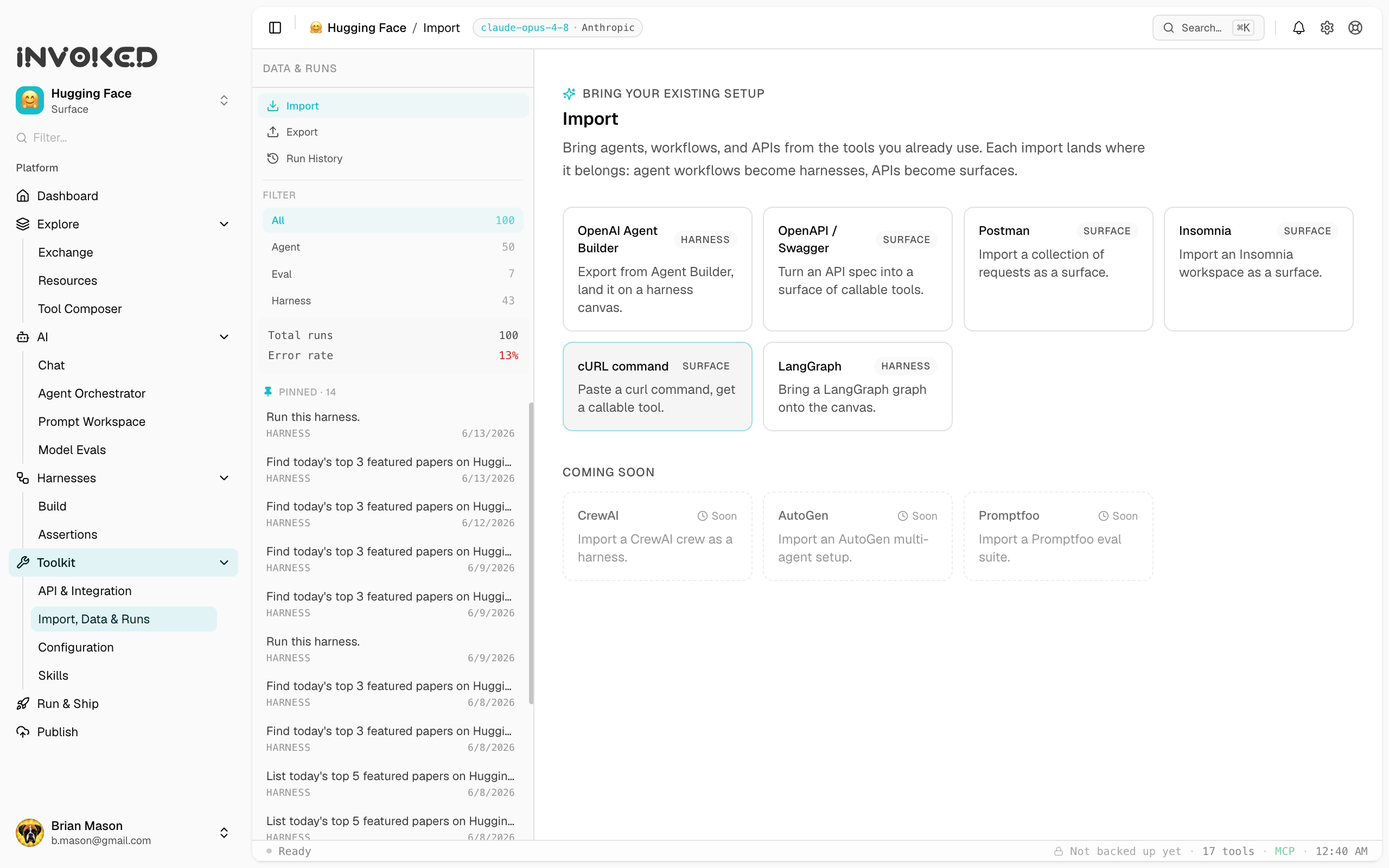
The Import hub is Invoked's front door for bringing in work you already have. Instead of rebuilding from scratch, you point Invoked at an export from another tool and it reconstructs the equivalent Invoked artifact, then shows you an honest summary of what carried over and what to review.
Open it from Toolkit → Import, Data & Runs → Import in the left sidebar, alongside Export and Run History — your data, in and out, in one place.
How it works
Every import follows the same flow, whatever the source:
- Pick a source from the catalog (OpenAI Agent Builder, LangGraph, OpenAPI/Swagger, Postman, Insomnia, cURL).
- Provide the export — choose a file, or paste (for cURL).
- Review the preview — Invoked confirms the detected format, shows a count of what it mapped (agents, endpoints, tools, connections…), lists what carried over, and flags anything to review.
- Import — the artifact is created and you're sent to refine it.
Nothing in your file is executed. Invoked only reads its structure.
Where each import lands
Imports are routed to the right kind of artifact:
| Source | Becomes a… |
|---|---|
| OpenAI Agent Builder | Harness |
| LangGraph | Harness |
| OpenAPI / Swagger | Surface |
| Postman | Surface |
| Insomnia | Surface |
| cURL | Surface |
Agent workflows describe how agents collaborate, so they become harnesses. API definitions describe endpoints you can call, so they become surfaces whose tools your agents and chats can use.
Sources
OpenAI Agent Builder
Export your workflow or prompt from Agent Builder as JSON, then import it as a harness. Invoked accepts both shapes Agent Builder produces: a full workflow graph (multiple steps become a multi-node harness) and a single prompt export (becomes a one-step harness you can extend). Instructions, model, and tools are mapped onto the canvas; conditional branches are imported as plain links to re-wire. See the dedicated migration guide.
LangGraph
Paste a LangGraph graph and bring it onto the harness canvas. Nodes become steps, edges become connections, and conditional routing is carried over as links you can re-wire. The preview reports what mapped — nodes, routing, guardrail detection, and the graph's State schema as typed inputs — plus an honest note of anything that didn't. Migrate an existing LangGraph agent instead of rebuilding it.
OpenAPI / Swagger
Import an OpenAPI 3.0 / 3.1 or Swagger 2.0 document in JSON or YAML. Every path and operation becomes a callable REST tool on a new, dedicated surface — the import never merges into whichever surface is currently active, so a large spec lands as its own clean surface with all its tools. The base URL is taken from the spec's servers (or host + basePath), and the auth scheme is inferred from the security definitions. If the spec's server URL is relative (no host), set the surface's base URL after import; add your token or key to the surface's credentials the same way — see editing a surface.
Postman
Import a Postman collection exported as Collection v2.1 (JSON). Requests across folders are flattened into one surface, with each request becoming a tool. Postman environment variables ({{...}}) aren't imported, so set the base URL and any credentials on the surface afterward.
Insomnia
Import an Insomnia v4 (JSON) export. Each request resource becomes a tool on a new surface. Insomnia template variables ({{ _.var }}) aren't imported; set the base URL and credentials on the surface after import.
cURL
Paste a curl command to turn a single request into a callable tool on a surface. Invoked parses the method, URL, query string, headers (inferring the auth scheme), and body. Add your real credentials to the surface afterward — they aren't imported from the command.
Coming soon
These sources are on the roadmap and appear in the hub as "coming soon":
- CrewAI — import a CrewAI crew as a harness.
- AutoGen — import an AutoGen multi-agent setup.
- Promptfoo — import a Promptfoo eval suite.
After importing
- Surfaces: open Surfaces, set the base URL if needed, add credentials, and call the tools from Chat or a harness.
- Harnesses: open Harnesses → Build to review the steps, refine prompts, connect each tool to a surface, and run it.
Imported artifacts are personal to your workspace until you explicitly share them with your team.